

What you’ll learn:
- Why patients with Single-Sided Deafness (SSD) represent a unique population where frequency allocation adjustments may be needed
- Practical programming strategies to optimize sound quality for SSD recipients
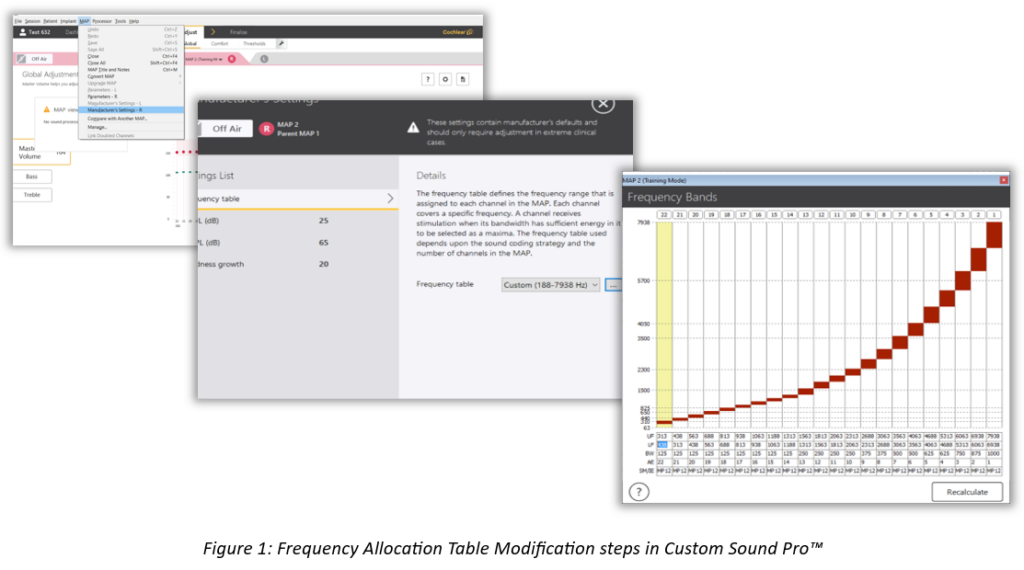
- How to modify Custom Sound Pro’s Frequency Allocation Tables
Modern cochlear implant systems that incorporate evidence-based frequency allocation approaches offer an important advantage: they provide a validated foundation while maintaining flexibility for individualized adjustments when clinically indicated. As discussed last week, this balanced approach recognizes that while critical band-based frequency allocation demonstrates superior outcomes across the general cochlear implant population, specific patient populations may benefit from Frequency Allocation Table (FAT) modifications. Access last week’s article here: The Science of Individualized Programming: Built on Decades of Auditory System Research.
Why SSD can require individualized frequency allocation
Patients with single-sided deafness (SSD) represent one population where frequency allocation modification can address unique clinical needs. These individuals maintain normal acoustic hearing in the contralateral ear, creating potential for place-pitch mismatch between the implanted and acoustic sides. Several strategies exist to reduce place-pitch mismatch in SSD patients: perimodiolar electrode array selection, natural adaptation over time, and individualized frequency allocation adjustments when clinically indicated. Perimodiolar positioning achieves closer proximity to spiral ganglion cells, resulting in more focused neural stimulation and improved speech perception.1 Recent studies have also demonstrated reduced mismatch for perimodiolar arrays when compared to lateral wall arrays.2 Natural tonotopic reorganization can further address place-pitch mismatch over time.3 For patients who report persistent pitch mismatch despite these factors, simple FAT modifications can be made within Custom Sound Pro™ without the need for additional imaging.3,4
The ability to modify frequency allocation tables within Custom Sound Pro™ allows clinicians to optimize binaural integration while maintaining the evidence-based frequency table foundation that benefits most patients. To optimize sound quality, clinicians may provide MAPs with alternate low frequency cut-offs such as 188 Hz, 438 Hz, and 563 Hz. Alternate FAT settings can be provided at initial activation, or during follow-up appointments if place-pitch mismatch persists. Trialing multiple settings empowers patients to identify their preferred MAP before the next clinical visit, optimizing both sound quality and performance outcomes. 3,4,5
To learn more about clinical considerations for adults with Single-Sided Deafness from industry experts, check out the white paper, “2024 Clinical Recommendations for the Treatment of Unilateral Hearing Loss/Single-Sided Deafness with Cochlear Implantation.”
- Holden LK, Finley CC, Firszt JB, Holden TA, Brenner C, Potts LG, et al. Factors affecting open-set word recognition in adults with cochlear implants. Ear Hear. 2013 May-Jun; 34(3):342–60.
- Danielian A, Ishiyama G, Lopez IA, Ishiyama A. Morphometric linear and angular measurements of the human cochlea in implant patients using 3-dimensional reconstruction. Hear Res. 2020 Feb;386:107874. doi: 10.1016/j.heares.2019.107874. Epub 2019 Dec 20. PMID: 31893539; PMCID: PMC7100312.
- Landsberger DM, Svrakic M, Roland JT Jr, Svirsky M. The Relationship Between Insertion Angles, Default Frequency Allocations, and Spiral Ganglion Place Pitch in Cochlear Implants. Ear Hear. 2015 Sep-Oct;36(5):e207-13. doi: 10.1097/AUD.0000000000000163. PMID: 25860624; PMCID: PMC4549170.
- Tóth TF, Németh A, Bakó P, Révész P, Gerlinger I, Szanyi I. Matching the pitch perception of the cochlear implanted ear with the contralateral ear in patients with single-sided deafness: a novel approach. European Archives of Oto-Rhino-Laryngology. 2023 280:4851-4859. https://doi.org/10.1007/s00405-023-08002-z
- Sagi E, Azadpour M, Neukam J, Capach NH, Svirsky MA. Reducing interaural tonotopic mismatch preserves binaural unmasking in cochlear implant simulations of single-sided deafness. Journal of the Acoustical Society of America. 2021;150(4):2316-2326.