

The human cochlea is a complex and delicate structure, where anatomical precision plays a critical role in cochlear implant outcomes. Electrode design is central to how effectively electrical stimulation interfaces with the auditory nerve and how well cochlear structures are preserved. As a result, decisions made at the time of implantation, particularly regarding electrode selection and placement, can have a direct and lasting impact on patient outcomes from the very start of their hearing journey.
Evolution of perimodiolar electrodes
Advancements in perimodiolar technology have significantly improved insertion performance compared to legacy designs (Contour Advance). Modern slim perimodiolar electrodes are engineered for atraumatic insertion and consistent intracochlear positioning and are 60% smaller than legacy electrodes.
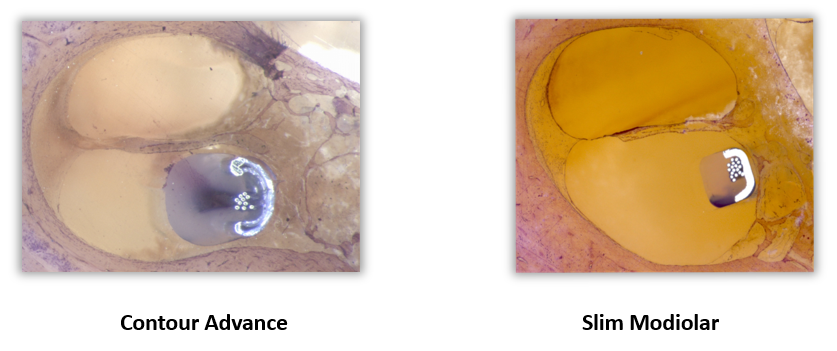
Across multiple studies, slim perimodiolar electrodes demonstrate lower translocation rates compared to older perimodiolar designs.

A cross-study comparison conducted by Dhanasingh et al. showed that lateral wall electrodes have a translocation rate of 6.7%.4,*
Superior hearing outcomes supported by high-level evidence
A growing body of high-quality evidence demonstrates that perimodiolar electrodes are associated with superior hearing outcomes. Duckett et al. (2025)5 reported significant advantages in word recognition in quiet.
Additional high-quality studies further reinforce these findings, showing:
- Improved speech understanding and hearing preservation (Holder et al., 2019)6
- Higher CNC scores and superior melody perception (Sturm et al., 2021)7
- Superior speech outcomes across multiple timepoints, including 6–12 months and beyond (Sharma et al., 20228; Vohra et al., 20249; Pennington-FitzGerald et al., 202510)
- Better early auditory and language outcomes, particularly in pediatric populations (Tuset et al., 2026)11
Increasing evidence for hearing preservation
Emerging data also suggests advantages in hearing preservation with slim perimodiolar electrodes. Studies report stable hearing preservation outcomes over time, compared with declines observed in other electrode types (Geng et al., 202512; Sakmen et al., 202513). This aligns with the Slim Modiolar design goal of minimizing intracochlear trauma and preserving residual hearing.
Electrode selection is a critical determinant of both surgical and long-term patient outcomes. The evidence demonstrates that modern perimodiolar electrodes provide a meaningful combination of precise neural targeting, consistent insertion quality, and reduced intracochlear disruption.
By aligning electrode design with cochlear anatomy and supported by robust clinical evidence, perimodiolar electrodes offer a clinically grounded approach to improving early performance, supporting better speech understanding, and enabling sustained outcomes over time. Together, these advantages help position patients for the strongest possible start to their hearing journey, beginning at the time of implantation.
Review more evidence that supports perimodiolar electrodes:
- Shaul, C., Weder, S., Tari, S., Gerard, J. M., O’Leary, S. J., & Briggs, R. J. (2020). Slim, Modiolar Cochlear Implant Electrode: Melbourne Experience and Comparison With the Contour Perimodiolar Electrode. Otology & neurotology : official publication of the American Otological Society, American Neurotology Society [and] European Academy of Otology and Neurotology, 41(5), 639–643. https://doi.org/10.1097/MAO.0000000000002617
- Beck, R., Aschendorff, A., Arndt, S., Hildenbrand, T., Rauch, A. K., & Ketterer, M. C. (2024). Evaluation of insertion quality of a slim perimodiolar electrode array. European archives of oto-rhino-laryngology : official journal of the European Federation of Oto-Rhino-Laryngological Societies (EUFOS) : affiliated with the German Society for Oto-Rhino-Laryngology – Head and Neck Surgery, 281(3), 1215–1220. https://doi.org/10.1007/s00405-023-08212-5
- Liebscher, T., Mewes, A., Hoppe, U., Hornung, J., Brademann, G., & Hey, M. (2021). Electrode Translocations in Perimodiolar Cochlear Implant Electrodes: Audiological and Electrophysiological Outcome. Zeitschrift fur medizinische Physik, 31(3), 265–275. https://doi.org/10.1016/j.zemedi.2020.05.004
- Dhanasingh, A., & Jolly, C. (2019). Review on cochlear implant electrode array tip fold-over and scalar deviation. Journal of otology, 14(3), 94–100. https://doi.org/10.1016/j.joto.2019.01.002
- Duckett, K. A., Kassir, M. F., Munhall, C. C., Schvartz-Leyzac, K. C., Nguyen, S. A., & Labadie, R. F. (2026). Does cochlear implant electrode array design affect audiologic outcomes? A systematic review and meta-analysis. Acta oto-laryngologica, 146(2), 159–175. https://doi.org/10.1080/00016489.2025.2451074
- Holder, J. T., Yawn, R. J., Nassiri, A. M., Dwyer, R. T., Rivas, A., Labadie, R. F., & Gifford, R. H. (2019). Matched Cohort Comparison Indicates Superiority of Precurved Electrode Arrays. Otology & neurotology : official publication of the American Otological Society, American Neurotology Society [and] European Academy of Otology and Neurotology, 40(9), 1160–1166. https://doi.org/10.1097/MAO.0000000000002366
- Sturm, J. J., Patel, V., Dibelius, G., Kuhlmey, M., & Kim, A. H. (2021). Comparative Performance of Lateral Wall and Perimodiolar Cochlear Implant Arrays. Otology & neurotology : official publication of the American Otological Society, American Neurotology Society [and] European Academy of Otology and Neurotology, 42(4), 532–539. https://doi.org/10.1097/MAO.0000000000002997
- Sharma, R. K., Smetak, M. R., Patro, A., Lindquist, N. R., Perkins, E. L., Holder, J. T., Haynes, D. S., & Tawfik, K. O. (2022). Speech Recognition Performance Differences Between Precurved and Straight Electrode Arrays From a Single Manufacturer. Otology & neurotology : official publication of the American Otological Society, American Neurotology Society [and] European Academy of Otology and Neurotology, 43(10), 1149–1154. https://doi.org/10.1097/MAO.0000000000003703
- Vohra, V., Andresen, N. S., Carver, C., Dunham, R., Marsiglia, D., Yeagle, J., Della Santina, C. C., Creighton, F. X., Jr, Bowditch, S. P., & Sun, D. Q. (2024). Cochlear Implant Electrode Array Design and Speech Understanding. Otology & neurotology : official publication of the American Otological Society, American Neurotology Society [and] European Academy of Otology and Neurotology, 45(2), 136–142. https://doi.org/10.1097/MAO.0000000000004083
- Pennington-FitzGerald, W., Waring, N. A., Hamiter, M., Kuhlmey, M., & Kim, A. H. (2025). Impact of Cochlear Implant Electrode Array Design on Post-Op Speech Perception. Otolaryngology–head and neck surgery : official journal of American Academy of Otolaryngology-Head and Neck Surgery, 172(3), 960–966. https://doi.org/10.1002/ohn.995
- Tuset, M. P., Bois, E., Noel-Petroff, N., Teissier, N., Van Den Abbeele, T., & Benoit, C. (2026). Comparison of Slim Perimodiolar and Slim Straight Electrode Arrays in Pediatric Cochlear Implantation: A Radiologic, Electrophysiological, and Audiological Study. Otology & neurotology : official publication of the American Otological Society, American Neurotology Society [and] European Academy of Otology and Neurotology, 47(3), 447–455. https://doi.org/10.1097/MAO.0000000000004784
- Geng, S., Wijewickrema, S., Copson, B., Gerard, J. M., & O’Leary, S. (2025). Hearing Preservation of Slim Modiolar and Slim Straight Electrodes: A Systematic Review and Meta-Analysis. Otology & neurotology : official publication of the American Otological Society, American Neurotology Society [and] European Academy of Otology and Neurotology, 46(7), 733–742. https://doi.org/10.1097/MAO.0000000000004540
- Dawood, E., Lee, L., Alsaadawi, R., Lee, J. H., Sabo, R., French, E., Coelho, D. H., & Manzoor, N. F. (2026). Investigating Hearing Loss and Cochlear Implantation Disparities Through the County Health Rankings System. Otolaryngology–head and neck surgery : official journal of American Academy of Otolaryngology-Head and Neck Surgery, 174(1), 210–218. https://doi.org/10.1002/ohn.70046
*Cross‑study comparisons are limited by differences in study design, populations, and endpoints.