

Evidence-Based Guidance for Pediatric Hearing Care
Cochlear implants (CIs) have transformed hearing care for many children with significant hearing loss, yet utilization remains low in the United States. Research suggests that only about 50% of children with severe-to-profound sensorineural hearing loss in the United States receive a cochlear implant,1,2 despite the well-established benefits of cochlear implantation for children who meet candidacy criteria.
The reasons for this gap are complex and multifactorial. While some patient variables may be difficult to address directly (e.g. socioeconomic status, race, geographical location), referral practices and clinician awareness represent opportunities to support timely evaluation. In response to this need, Dr. Jourdan Holder, Dr. Andrea Warner-Czyz, and Dr. Lisa Park collaborated to create evidence-informed referral recommendations to help clinicians identify children who may benefit from a cochlear implant candidacy evaluation. Their work led to the development of the Pediatric CI 3-60 Referral Guideline, a practical framework based on measures routinely collected during pediatric hearing care. This article summarizes the key findings from their research and incorporates additional insights shared by the authors during a recent discussion on the clinical rationale and practical application of the guideline. For clinicians who may not routinely manage pediatric cochlear implant candidates, the Pediatric CI 3-60 Referral Guideline offers simple, evidence-informed referral criteria that can be readily incorporated into everyday practice to support timely evaluation.
Building on a Familiar Adult Referral Framework

Many hearing care professionals are already familiar with the adult “60/60” referral guideline published by Terry Zwolan and colleagues in 2020.3 That guideline recommends referral for a cochlear implant evaluation when adults present with a pure-tone average of 60 dB HL or greater and word recognition scores of 60% or poorer. The goal was to provide a memorable, easy-to-use referral tool based on measures routinely collected during audiologic evaluations.
The Pediatric CI 3-60 Guideline follows a similar philosophy while accounting for the unique challenges of pediatric assessment. Because many young children cannot reliably complete open-set speech recognition testing, the pediatric guideline incorporates aided Speech Intelligibility Index (SII), an objective measure of speech audibility that can be obtained during hearing aid verification.
The Pediatric CI 3-60 Referral Guideline
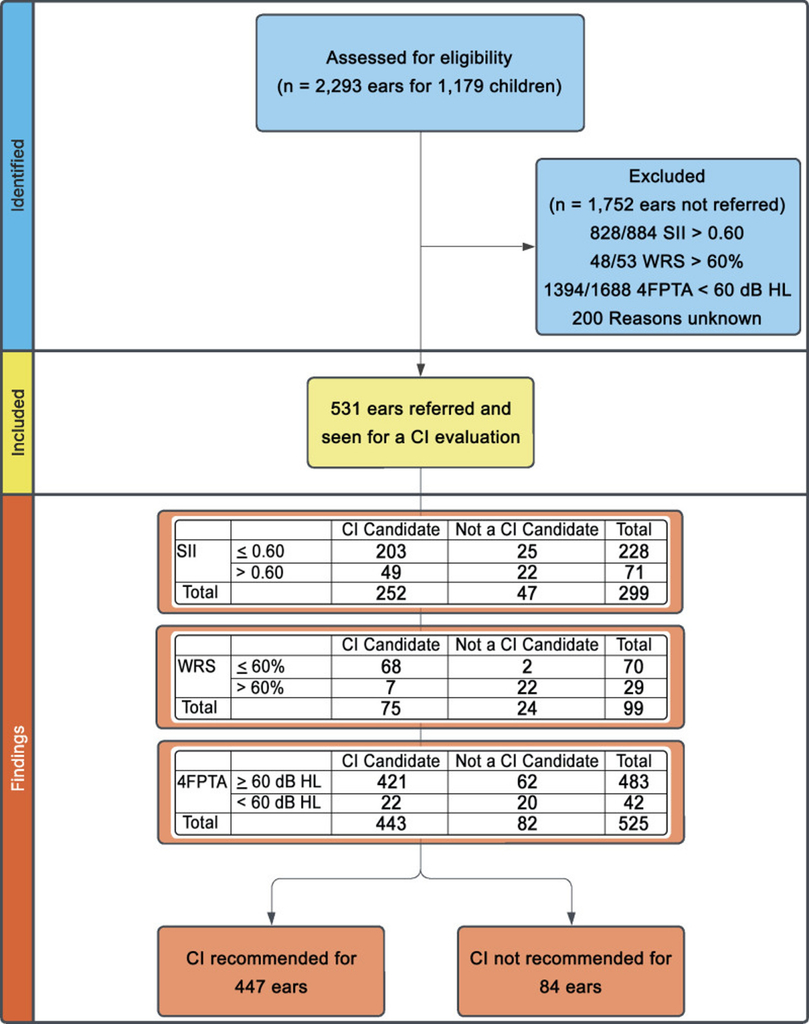
To develop the Pediatric CI 3-60 Referral Guideline, Dr. Holder, Dr. Warner-Czyz, and Dr. Park conducted a retrospective, multicenter review4 of hearing evaluations performed at three major pediatric cochlear implant centers in the United States. The study included data from 1,179 children younger than 14 years of age collected between January 2020 and December 2021. Researchers analyzed audiometric measures commonly obtained in pediatric hearing care, including four-frequency pure-tone average (4FPTA), aided Speech Intelligibility Index (SII), and aided word recognition scores (WRS), and compared these findings with cochlear implant evaluation recommendations to identify referral criteria that would capture the majority of children ultimately recommended for implantation.
The study supports referral for a cochlear implant candidacy evaluation when a child meets any one of the following ear-specific criteria:
• Unaided four-frequency pure-tone average (4FPTA) ≥60 dB HL
• Aided Speech Intelligibility Index (SII) ≤0.60
• Aided word recognition score (WRS) ≤60% correct, when available
Importantly, these criteria are intended as independent referral triggers, not requirements that must all be present. The investigators found that 94% of ears ultimately recommended for implantation met at least one of these criteria, supporting the use of CI 3-60 as a referral framework for identifying children who may benefit from a comprehensive evaluation.
Dr. Holder explained, ”We wanted to capture all of the patients that could possibly be a cochlear implant candidate rather than the opposite.” She noted that requiring multiple referral criteria would have resulted in more children who were ultimately recommended for implantation being missed during the referral process.
Why Include 4,000 Hz in the Pure-Tone Average?
Unlike traditional three-frequency PTAs, the CI 3-60 guideline incorporates 4,000 Hz into the average. The authors selected a four-frequency approach because high-frequency audibility plays an important role in speech understanding and spoken language development in children.5-10
Dr. Park emphasized, “For children, getting that high frequency information is so important for learning grammar, for just learning language in general. In English, we have so many high frequency sounds, so many fricatives, and we know that they need those words…so capturing 4000 Hz helps us make sure that we’re accounting for those kids with high frequency hearing loss.”
The Value of Measuring Audibility
One of the most notable aspects of the pediatric guideline is its emphasis on aided audibility through SII. The study found that 94% of ears recommended for implantation had an aided SII of 0.60 or lower.
SII provides valuable information about how much speech is accessible through appropriately fitted hearing aids. This can be particularly useful in infants, toddlers, and children who are unable to complete speech recognition testing. In their study, only 23% of children undergoing cochlear implant evaluation were able to complete aided open-set speech recognition testing.
Dr. Warner-Czyz explained, “Audibility is the key to aided speech intelligibility index. And it gives us a way to not just look at the frequencies, but to look at the importance of those frequencies to learning all of the speech and language aspects…” She further noted that SII provides clinicians with an objective way to evaluate access to the speech information needed for speech and language development.
Referral Is the Beginning of the Conversation
A critical point for referring professionals is that a referral for a cochlear implant evaluation is not the same as determining candidacy or recommending implantation.
Rather, referral provides an opportunity for a comprehensive assessment by an experienced cochlear implant team. The evaluation process considers many factors beyond the screening measures used in CI 3-60 and helps families better understand available hearing technology options and potential next steps.
The study authors emphasize that not every child referred for evaluation will ultimately proceed with implantation. However, timely referral can help ensure that children receive appropriate assessment and counseling when needed.
Similarly, Dr. Holder shared an important reminder that “no referral is a bad referral,“ emphasizing that the evaluation process itself can provide valuable education and guidance for families regardless of the outcome.
Clinical Takeaway
The Pediatric CI 3-60 Guideline offers clinicians a practical, evidence-informed referral framework that aligns with the widely recognized adult 60/60 guideline while addressing the realities of pediatric hearing care.
When a child demonstrates an unaided 4FPTA of 60 dB HL or greater, an aided SII of 0.60 or lower, or an aided word recognition score of 60% or less when available, referral for a cochlear implant candidacy evaluation should be considered. By incorporating these measures into routine pediatric hearing care, clinicians can support more consistent referral practices and help ensure children receive timely access to comprehensive evaluation, counseling, and discussion of available hearing technology options.
Read the full study: Pediatric CI 3-60 Guideline: When to Refer Children for a Cochlear Implant Candidacy Evaluation – PMC

To learn more about the clinical rationale behind the Pediatric CI 3-60 Referral Guideline and to hear from the experts involved in the study, listen to this episode on Beyond the Decibels: Dr. Holder, Dr. Park & Dr. Warner-Czyz: When Should Pediatric Referrals Happen?
- Bradham, T., & Jones, J. (2008). Cochlear implant candidacy in the United States: Prevalence in children 12 months to 6 years of age. Int J Pediatr Otorhinolaryngol, 72, 1023–1028.
- Sorkin, D. L., & Buchman, C. A. (2016). Cochlear implant access in six developed countries. Otol Neurotol, 37, e161–e164.
- Zwolan, T. A., Schvartz-Leyzac, K. C., & Pleasant, T. (2020). Development of a 60/60 Guideline for Referring Adults for a Traditional Cochlear Implant Candidacy Evaluation. Otology & neurotology : official publication of the American Otological Society, American Neurotology Society [and] European Academy of Otology and Neurotology, 41(7), 895–900. https://doi.org/10.1097/MAO.0000000000002664
- Holder, J. T., Warner-Czyz, A. D., & Park, L. R. (2026). Pediatric CI 3-60 Guideline: When to Refer Children for a Cochlear Implant Candidacy Evaluation. Ear and hearing, 47(5), 1187–1196. https://doi.org/10.1097/AUD.0000000000001812
- Stelmachowicz, P. G., Pittman, A. L., Hoover, B. M., Lewis, D. E. (2001). Effect of stimulus bandwidth on the perception of/s/ in normal-and hearing-impaired children and adults. J Acoust Soc Am, 110, 2183–2190.
- Stelmachowicz, P. G., Pittman, A. L., Hoover, B. M., Lewis, D. E., Moeller, M. P. (2004). The importance of high-frequency audibility in the speech and language development of children with hearing loss. Arch Otolaryngol Head Neck Surg, 130, 556–562.
- Stelmachowicz, P. G., Lewis, D. E., Choi, S., Hoover, B. (2007). Effect of stimulus bandwidth on auditory skills in normal-hearing and hearing-impaired children. Ear Hear, 28, 483–494.
- Pittman, A. L. (2008). Short-term word-learning rate in children with normal hearing and children with hearing loss in limited and extended high-frequency bandwidths. J Speech Lang Hear Res, 51, 785–797.
- Walker, E. A. (2023). The importance of high-frequency bandwidth on speech and language development in children: A review of Patricia Stelmachowicz’s contributions to pediatric audiology. Semin Hear, 44 (Suppl 1), S3–S16.
- Eisenberg, L. S., Shannon, R. V., Martinez, A. S., Wygonski, J., Boothroyd, A. (2000). Speech recognition with reduced spectral cues as a function of age. J Acoust Soc Am, 107, 2704–2710.