

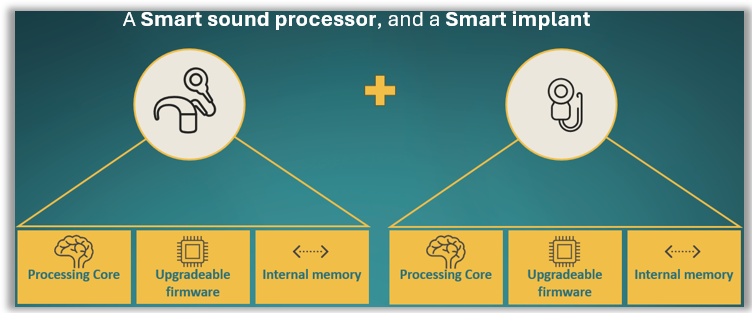
The Cochlear™ Nucleus® Nexa® System stands alone as the world’s first and only smart cochlear implant system1,* because it uniquely integrates true intelligence into the architecture itself. The Cochlear Nucleus Nexa System represents a fundamental technological transformation that changes what is possible for recipients over their lifetime. Historically, traditional cochlear implant systems have intelligence only in the sound processor. For a cochlear implant system to be smart, intelligence must exist in both parts of the system.
Smart Architecture
The Nucleus Nexa System has three essential architectural components working together:
- an onboard processing core capable of real-time signal processing and decision-making within the implant itself
- upgradeable firmware that enables the device to evolve without surgical revision
- internal memory for storing patient-specific settings, diagnostic data and processing algorithms.
These components reside within the implant, not the external processor, and are what qualify it as smart implant technology.
Onboard Intelligence: Real-Time Processing Inside the Implant
The Nexa implant contains a computing engine that performs real-time analysis and optimization independent of the external sound processor. This onboard intelligence enables several clinically relevant capabilities. The Nexa implant continuously monitors§ and responds to its operating environment and stimulation requirements in real time, reducing clinical burden while optimizing patient experience.
One example of this onboard intelligence is Onboard Diagnostics, where the implant continuously monitors its performance and can detect and respond to potential issues before they affect patient outcomes. When the implant identifies suboptimal coil placement, it can notify the recipient directly through the sound processor, enabling immediate correction rather than requiring a troubleshooting call to the clinic. In the most extreme (and rare) cases where the implant detects conditions that could compromise safety or performance, it can reset or lock until the issue is resolved. These capabilities shift the system from reactive troubleshooting to proactive performance management.
Another example of this onboard intelligence is Dynamic Power Management. The Nexa implant continuously monitors the power required for optimal stimulation based on each patient’s individual MAPs and their current stimulation needs. The implant then adjusts how much power it requests from the sound processor in real time. For audiologists, this may translate to fewer patient complaints about inconsistent battery life, reduced out-of-compliance events that require clinic attention, and more predictable device performance across varying listening environments. For recipients, increased power efficiency means they can access even smaller sound processors without sacrificing all-day hearing.2,# through the new Power Compact Rechargeable battery module.
Firmware Upgradeability: Evolution Without Revision Surgery
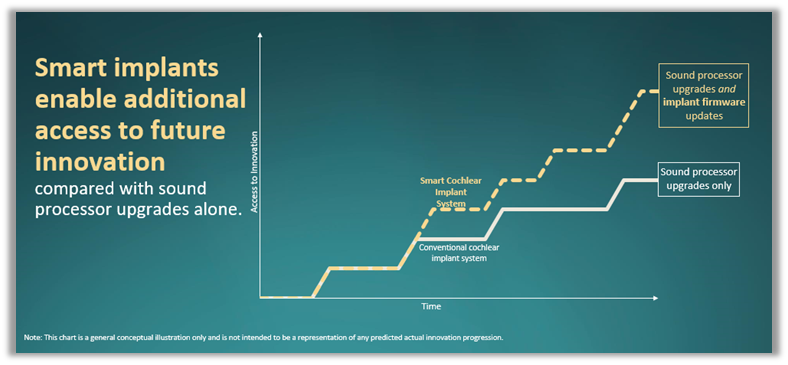
Perhaps the most significant architectural advantage of smart implant technology is upgradeable firmware. Examples of devices that currently receive firmware updates to improve performance include medical devices such as pacemakers and blood glucose monitors, as well as consumer technologies like smartphones and electric cars.
The Nucleus Nexa Implant firmware can be updated through Custom Sound Pro. For patients who will live with their implants for decades, firmware upgradeability means the device they receive today can incorporate future advances. Examples of such advances that could be provided without requiring revision surgery include new signal processing and stimulation strategies, and diagnostics. For recipients focused on the newest technology, it provides assurance that their implant will remain current as cochlear implant technology advances. Clinically, firmware updates enable providers to implement new features, optimize existing functions, and continue to improve patient outcomes.
Internal Memory: Continuity and Diagnostic Capability
The third architectural pillar of smart implant technology is internal memory within the implant itself. The Nucleus Nexa System stores patient-specific programming parameters, diagnostic logs, usage data and stimulation history directly in the implant. This seemingly simple capability has several important clinical implications.
When patients replace external processors or lost or damaged equipment, their custom settings are preserved in the implant and automatically transferred to the new processor via Smart Sync—Cochlear’s seamless data transfer system. This eliminates the need for clinic intervention and ensures continuity of their hearing. Internal memory also enables more sophisticated diagnostic capabilities, as the implant can track performance trends over time, identify patterns that might indicate developing issues and provide clinicians with objective data about device function and patient usage.
Guiding Patient Decisions with Confidence
Over a recipient’s lifetime, their implant may remain in place for decades. As clinicians who guide patients and families through one of the most important decisions of their lives, understanding what makes an implant truly smart matters. It’s the foundational architecture that enables clinical adaptability and determines whether the device implanted today can evolve to meet changing patient needs throughout their lifetime, without requiring another surgery. The Nucleus Nexa System is the only system with this architectural foundation to meet these needs and offer patients more possibilities for a lifetime of better hearing.
Learn more about the Nucleus Nexa System’s smart features!
Visit our website for more details.
1 Cochlear Limited. FUN5261. FDA Approval Letter for CI1000 Series Implant System. 2025.
2 Cochlear Limited. D1190805 Processor Size Comparison. 2024, May.
*The first and only cochlear implant having onboard memory with upgradeable firmware.
^As future advancements or technology become available for the CI1000 series implant, a firmware update may be required in order to take advantage of newer features.
§Everyday monitoring refers to implant operational attributes that are logged on the implant.
## Battery life varies for every user, according to the age of the battery, the programs used each day, your implant type, the thickness of skin covering your implant, and the size and type of battery used. Streaming from compatible devices, True Wireless devices or FM may decrease sound processor battery life depending on how often and for how long streaming is engaged. Typical expected battery life is calculated using default map settings used with a CI1000 series implant. All day hearing is defined as 16 hours.