

Chronic middle ear disease represents a substantial global health challenge, affecting nearly 300 million people worldwide and creating complex management decisions for audiologists and surgeons alike. Chronic suppurative otitis media, one of the most common forms of chronic middle ear disease, causes disabling hearing loss in 62% of cases, with the global burden continuing to rise despite advances in medical and surgical care (Brennan-Jones et al., 2024; Wang et al., 2024).
These conditions, which include chronic suppurative otitis media and chronic otitis media with effusion, are characterized by persistent inflammation, structural changes to the tympanic membrane and middle ear space, and fluctuating conductive or mixed hearing loss that can significantly impact patients’ communication abilities and quality of life. Research demonstrates that children with chronic otitis media in the first three years are 2 to 3 times more likely to develop psychosocial difficulties including attention deficits, conduct issues, emotional problems, and poor peer relationships that persist into ages 10 to 11 (Roberts et al., 2004). These children exhibit fewer positive and negative verbal interactions and play alone more often in day care settings, exacerbating social isolation patterns.
The educational impact is equally concerning. Research indicates that chronic middle ear disease is associated with notable decreases in academic performance by age 7. Children with the greatest amount of effusion time exhibit lower verbal, reading, and math scores than peers with minimal effusion exposure (Teele et al., 1990). Speech and language development is particularly vulnerable, with children experiencing chronic otitis media, especially with right ear involvement and early onset before 12 months, showing significantly higher error rates in phonetic development (mean score 1.17 vs. 0.24 in controls) and phonological development (mean score 3.75 vs. 0.53, p<0.002). These delays subsequently impact syntax acquisition and reading readiness (Keogh et al., 2005).
In adults with chronic suppurative otitis media, bilateral involvement significantly increases activity restriction (mean CES* score 53.8±14.4 vs. 69.1±18.5 for unilateral, P<0.001) (Nadol et al., 2000). In another study, untreated hearing loss was associated with higher incidences of depression, fear of misunderstanding others, embarrassment, and overall impact on quality of life, as reported on the COMOT-15** (Lasisi et al., 2021).
Are We Addressing Hearing Loss in Chronic Middle Ear Disease Early Enough?
A challenging consideration facing otolaryngologists and audiologists is determining the optimal timing for hearing rehabilitation interventions, including bone conduction solutions. Should rehabilitation be introduced early in the disease process to minimize communication disruption, or should clinicians wait until medical and surgical options have been exhausted? How do we balance the potential for spontaneous resolution or successful surgical intervention with the documented risks of delayed auditory stimulation?
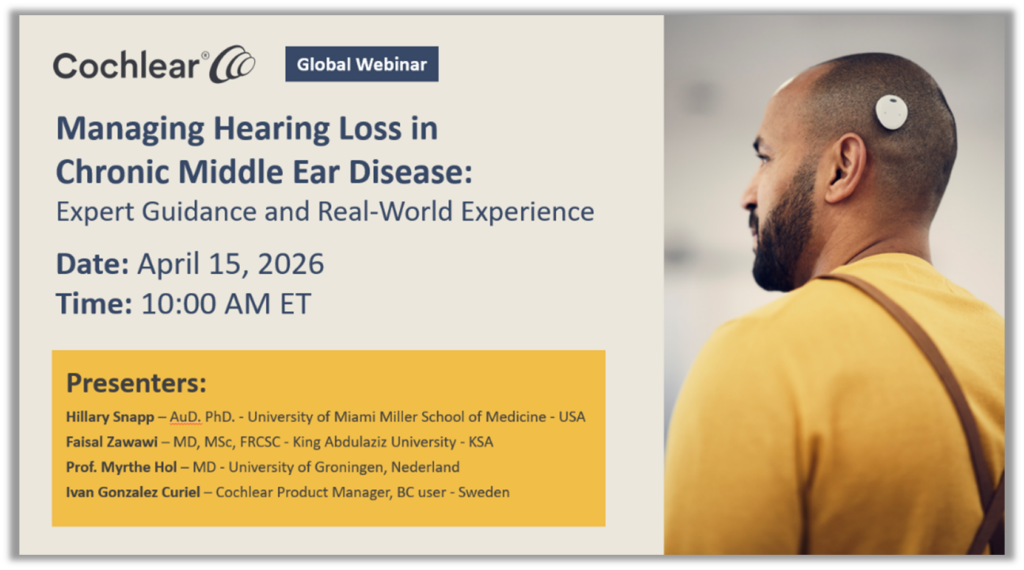
On April 15th, join leading experts Hillary Snapp, AuD, PHD, Faisal Zawawi, MD, and Myrta Hol, MD as they address these critical clinical questions in a comprehensive webinar that combines expert clinical guidance with real-world patient perspectives. This multidisciplinary panel will provide practical, evidence-based strategies for clinical decision-making, exploring:
- When to consider appropriate bone conduction solutions
- Why amplification can and should run in parallel with treatment
- Patient considerations beyond the air-bone gap
- Patient impact of delayed hearing intervention
Whether you’re managing pediatric patients with developmental concerns or adults navigating the complexities of chronic disease, this session will equip you with actionable insights to improve patient care and outcomes.
*The Chronic Ear Survey (CES) is an instrument to measure the impact of chronic otitis media and its treatment. The survey provides information regarding total ear-specific health, as well as subscore information regarding activity restriction, symptoms, and medical resource usage attributable to chronic otitis media.** The Chronic Otitis Media Outcome Test 15 (COMOT-15) is a validated tool that evaluates subjective improvements in symptoms, mental health, and social functioning.
- Brennan-Jones, C. G., et al. (2024). Global prevalence of chronic suppurative otitis media: A systematic review and meta-analysis. PMC, 11968643. https://pmc.ncbi.nlm.nih.gov/articles/PMC11968643/
- Wang, Y., et al. (2024). Global burden of otitis media from 1990 to 2019. PMC, 11008441. https://pmc.ncbi.nlm.nih.gov/articles/PMC11008441/
- Roberts, J. E., et al. (2004). Otitis media in early childhood in relation to children’s school-age language and academic skills. Pediatrics, 113(4), 696-706.
- Teele, D. W., et al. (1990). Otitis media in infancy and intellectual ability, school achievement, speech, and language at age 7 years. Journal of Infectious Diseases, 162(3), 685-694.
- Keogh, T., et al. (2005). The impact of chronic otitis media on phonological development in children. International Journal of Pediatric Otorhinolaryngology, 69(5), 631-640.
- Lasisi, A. O., et al. (2021). Quality of life assessment in patients with chronic suppurative otitis media. Journal of Laryngology and Otology, 135(3), 234-239.
- Nadol, J. B., et al. (2000). Chronic otitis media and its effects on hearing and quality of life. Otolaryngology–Head and Neck Surgery, 123(6), 726-732.
Views expressed are those of the individual. Consult your hearing health provider to determine if you are a candidate for Cochlear technology. Outcomes and results may vary.