
Since the first home game consoles in the early 1970s to arcades booming later that decade, video games have become a part of American culture1. They enable connections across homes, counties, states and even continents allowing for shared experience. The Entertainment Software Association’s (ESA) most recent survey of American gamers notes that 64% of the U.S. population plays video games at least an hour a week with the average gamer being 36 years of age2. Games aren’t just for kids. They allow connections to families, friends, and strangers all over the world.
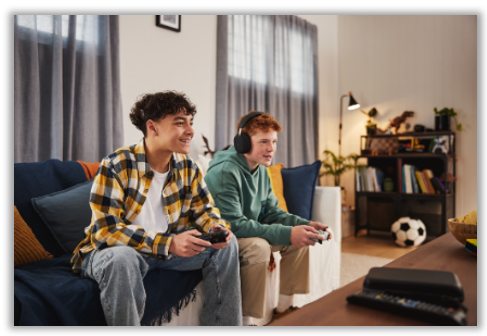
With over 3.2 billion active video gamers worldwide and approximately 20% of the world’s population1 having some type of hearing loss—it is expected that there is overlap between these two groups. Electronic Arts even suggest that 15% of gamers have some type of hearing loss3. Gaming continues to foster connection and communication and as hearing professionals, we can do better to allow access for those who are experiencing hearing loss. Individuals with hearing loss are noted to need an increased signal to noise ratio (SNR) in most listening situations, including gaming4. Many devices have noise cancellation and specific features to increase the SNR; however, anything providers can do to increase the signal is beneficial for clarity. Cochlear’s SCAN 2 ForwardFocus* can be beneficial in a variety of situations but it may still not be enough to enjoy video games as intended5.
An easy solution is to use other communication tools already available to hearing loss professionals. Bluetooth offers hearing loss professionals the prime opportunity. While it be lesser known that this technology was named after King Harald “Bluetooth” Gormsson–being obsessed with dark colored fruit or being a dead tooth – this technology is already well known to many professionals. Just like King Harald uniting Denmark and Norway, this technology – which is often used to pair hearing devices to PCs, tablets, and mobile devices—can also be used to foster a connection through games. Many gaming consoles, PCs, and mobile devices already have Bluetooth capabilities embedded within them; however, not all device users are aware of how to direct connect. PCs and mobile phones often connect directly to a Nucleus® 8 or a Kanso® 3 Sound Processor5,6 and directions are widely available to clinicians and patients alike. For console gaming, using accessories from Cochlear can help bridge any connection gaps. Some of the best tools are the Mini Mic 2+ and the Multi Mic auxiliary port7. An auxiliary cable from the microphone easily connects to most consoles through the controller or the console itself. Other options for connection include the TV streamer that will allow a console already connected to the television to stream to a Nucleus 8 or Kanso 3 Sound Processor7. However, some gamers have reported that connecting to the console itself has less audio lag in game play.
As gaming continues to evolve as a global platform for connection, entertainment, and inclusion, hearing care professionals have a unique opportunity to ensure that individuals with hearing loss are not left behind. By leveraging existing technologies like Bluetooth and Cochlear accessories, we can help patients access clearer, more immersive audio experiences—whether they’re battling dragons, racing cars, or simply chatting with friends online. Supporting connectivity in gaming isn’t just about sound – it’s about participation, engagement, and equity.

There are a variety of connection options available for Cochlear users and specific individual situations can be found by scanning this QR code or by clicking here.
To hear more about how gaming and hearing technology intersect, check out the Beyond the Decibels podcast episode “Leveling Up with a Cochlear Implant” featuring Dr. Kat Tribulski. In this insightful conversation, she shares personal stories and professional perspectives on how cochlear implants can transform the gaming experience for users with hearing loss. Listen to the episode here.
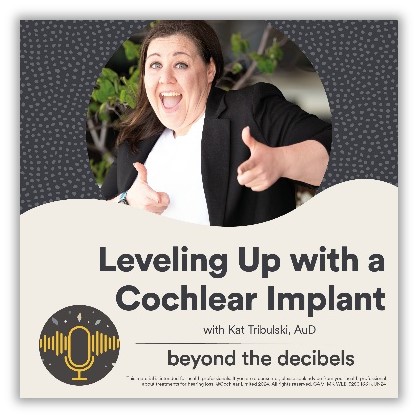

Dr. Kathryn “Kat” Tribulski is a pediatric audiologist at Nemours Children’s Hospital Delaware Valley. She received her doctorate in Audiology from Salus University in 2016. Prior to working at Nemours Delaware Valley, Dr. Tribulski worked at Tufts Medical Center in Boston, MA and Nemours Children’s Hospital, Orlando in Orlando, FL. Dr. Tribulski is a member of the American Cochlear Implant Alliance (ACIA) and an ACIA Pennsylvania State Champion. She is a member of The American Speech-Language Hearing association (ASHA) and has her certificate of clinical competency in audiology. In 2024 Dr. Tribulski obtained her Pediatric Audiology Specialty Certification. Throughout her career she has focused on pediatric care and cochlear implant technology/programming. When not practicing audiology, Dr. Tribulski likes to work in her resin craft workshop and play with her two goldendoodles.
Please note, this is an unmonitored mailbox. If you need assistance, please contact us here.
- Yanev, V. (2024, January 2). Video game demographics – who plays games in 2025?. TechJury. https://techjury.net/blog/video-game-demographics
- Clement, J. (n.d.). Topic: Video gaming worldwide. Statista. https://www.statista.com/topics/1680/gaming/#editorsPicks
- Media, A. B. (2024, March 22). The Essential Guide to gaming audiences. Adweek. https://www.adweek.com/sponsored/the-essential-guide-to-gaming-audiences/#:~:text=4)%2C%20multiplatform%20players%20largely%20identify%20as%20gamers,entertainment%2C%20playing%20over%2023%20hours%20each%20week.
- Grant KW, Walden TC. Understanding excessive SNR loss in hearing-impaired listeners. J Am Acad Audiol. 2013 Apr;24(4):258-73; quiz 337-8. doi: 10.3766/jaaa.24.4.3. PMID: 23636208.
- Nucleus 8 sound processor. Cochlear. (n.d.-a). https://www.cochlear.com/us/en/professionals/products-and-candidacy/nucleus/nucleus-sound-processors/nucleus-8-processor
- Nucleus® KANSO® 3 sound processor. Cochlear. (2025, December 8). https://www.cochlear.com/us/en/home/products-and-accessories/cochlear-nucleus-system/nucleus-sound-processors/kanso-3
- True Wireless™ Accessories. Cochlear. (n.d.). https://www.cochlear.com/us/en/home/products-and-accessories/our-accessories/true-wireless-devices
* SNR-NR, WNR and SCAN are approved for use with any recipient ages 6 years and older who is able to 1) complete objective speech perception testing in quiet and in noise in order to determine and document performance 2) report a preference for different program settings.
ForwardFocus can only be enabled by a hearing implant specialist. It should only be activated for users 12 years and older who are able to reliably provide feedback on sound quality and understand how to use the feature when moving to different or changing environments. It may be possible to have decreased speech understanding when using ForwardFocus in a quiet environment.
Views expressed are those of the individual. Consult your hearing health provider to determine if you are a candidate for Cochlear technology. Outcomes and results may vary.
This blog is intended to serve as a resource for clinicians to help keep up to date with current clinical literature and is intended for professionals only. Clinical literature is based on research, which may include the experimental use of new or currently available products and technologies. Therefore, literature presented on this blog may represent use of Cochlear products that does not align with the intended use or indications approved by regulatory bodies, also known as off-label use. Cochlear does not condone any off-label use of its products, and it is not Cochlear’s intent to promote off-label use by providing this blog as a resource for healthcare professionals.